We earn a commission from qualifying Amazon purchases at no extra cost to you. Learn more
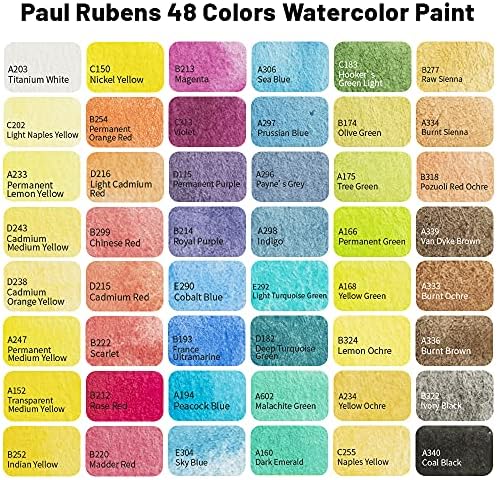
Paul Rubens doesn't have the brand recognition of Winsor & Newton, but the 48-color pan set genuinely earns its mid-range positioning. The pigment density is closer to artist quality than the student-grade price suggests, and the color range — particularly the earths and neutrals — goes places that Cotman doesn't. The lack of published lightfastness data per color is the main thing holding it back from a higher ranking.
Quick Specs
What's in the Box
You get 48 half-pans in a plastic case with a fold-out mixing palette. No brushes, no paper. The case is functional rather than premium — it won't last ten years of heavy use the way a Cotman tin will, but the paint quality more than makes up for the packaging.
The 48-color selection is where Paul Rubens distinguishes itself. Unlike budget sets that pad their count with near-duplicate variations on the same hue, this range includes a genuinely usable selection of earth tones — raw umber, burnt sienna, several ochres — plus a set of neutrals and grays that intermediate painters actually reach for. It's a more thoughtful palette than most sets at this price.
Performance
Pigment Quality and Transparency
The transparency on Paul Rubens paint is notably better than what you get from Arteza or Himi Miya. Diluted washes glow from the white paper underneath the way proper watercolor should, rather than sitting as a flat opaque layer. This is the quality that matters most for glazing and building up transparent washes — and Paul Rubens gets it right.
Pigment load is consistent across the set. Colors don't feel thin or washed out at working dilution. The phthalos are strong, the earth tones are rich, and the neutral grays behave predictably — none of them going chalky or shifting dramatically when dry.
Pan Activation and Re-wetting
Pans activate easily with a damp brush — no soaking required, no crumbling. The re-wetting behavior is one of the better qualities of this set. Come back to it after a week unused and the pans pick up paint immediately. The gum arabic binder formula is well-balanced, which explains the good transparency and clean re-wetting behavior.
Color shift from wet to dry is minimal — what you paint is close to what you get, which is not guaranteed at this price range. Several budget brands produce colors that look right wet and then dry lighter and more chalky. Paul Rubens doesn't do this.
Wet-on-Wet and Layering
Wet-on-wet works well for this grade of paint. Colors spread and bloom naturally into wet surfaces on Arches cold press — the results aren't as organic or luminous as Holbein artist-grade, but they're significantly better than student-grade paint. For practicing wet-on-wet foliage, skies, and loose landscape work, Paul Rubens is a capable tool.
Layering is clean. Dry glazes sit without lifting the layer underneath, which is important for building depth in a painting. At this price, that's a genuine achievement.
Lightfastness
Paul Rubens does not publish comprehensive ASTM lightfastness data for each individual color in this set. That's a notable gap. The pigment selection avoids the most obviously fugitive choices, and community testing has found the set to be reasonably stable — but without published ratings, you're relying on anecdotal reports rather than manufacturer data.
For practice work, sketchbooks, and displayed paintings in normal conditions, this is unlikely to matter. For archival or commissioned work where long-term color stability is a requirement, step up to Daniel Smith or Holbein where the lightfastness documentation is comprehensive and independently verifiable.
Pros and Cons
What Works
What Doesn't
How It Compares
Paul Rubens sits in an interesting gap in the market — better than most student-grade sets, not quite at the Daniel Smith or Holbein level, and priced accordingly. The closest comparison is Winsor & Newton Cotman, which is more widely available and has a longer track record, but fewer colors and slightly lower pigment density.
Want a complete kit at the same price?
The Tobios Watercolor Kit includes brushes, cold-press paper, and a palette — everything to start painting the day it arrives, for the same price as the Paul Rubens set alone.
Read the Tobios ReviewFrequently Asked Questions
Is Paul Rubens watercolor artist grade or student grade?
It sits in between. Paul Rubens markets the 48-color set as professional grade, and the pigment density is genuinely better than most student sets — closer to what you'd call a mid-grade artist quality. It's not in the same category as Daniel Smith or Holbein, but it's meaningfully better than Arteza or basic beginner sets.
How does Paul Rubens compare to Winsor & Newton Cotman?
Paul Rubens has better pigment density and a more interesting color range — particularly the earths and muted tones that Cotman skips. Cotman has broader availability and more predictable behavior. At roughly the same price, Paul Rubens gives you more paint quality; Cotman gives you more brand confidence and easier restocking.
Are Paul Rubens watercolors lightfast?
Better than budget brands, but Paul Rubens doesn't publish comprehensive ASTM lightfastness data for each color in the 48-set. For practice and display work in normal conditions, the pigment selection is reasonable. For archival or commission work where long-term stability is critical, Daniel Smith with published lightfastness data per color is a more reliable choice.
Can beginners use Paul Rubens watercolors?
Yes — the pans activate readily and the paint behaves well on cold press paper. The 48-color range is broad enough to feel complete without being overwhelming. The main caveat is that some colors are close variants of each other, so a beginner may not use all 48 effectively. For a first serious set, Tobios at a similar price point is a more complete kit including brushes and paper.
Paul Rubens vs Tobios — which is better for beginners?
Tobios is the better starter kit because it comes with brushes, cold-press paper, and a palette — you can start painting the day it arrives. Paul Rubens is just the paint set, so you need to buy brushes and paper separately. If you already have those supplies and want more color range, Paul Rubens at $32 for 48 colors is excellent value.