We earn a commission from qualifying Amazon purchases at no extra cost to you. Learn more
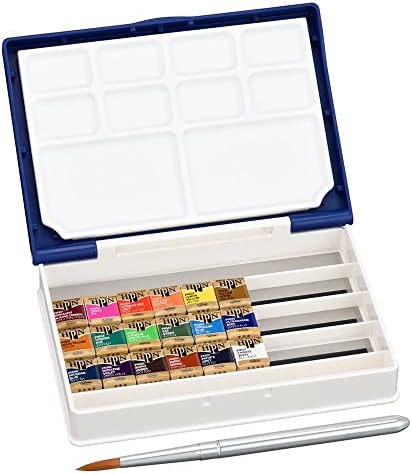
The no-ox-gall formula is not a marketing distinction — it genuinely changes how the paint moves. Wet-on-wet blooms spread evenly and consistently without the variable behavior you get from most artist-grade paint. The 18-color selection is thoughtful rather than comprehensive, and lightfastness ratings are strong across the board. The price is high. The paint lasts longer than it has any right to given the pan size.
Quick Specs
What's in the Box
Eighteen pans in a compact case. No brushes, no paper. The case is Holbein's standard plastic pan holder — functional and lighter than a tin, though less durable for heavy field use. The pans are a full half-pan size, and they can be popped out and replaced with tube paint refills when depleted.
The 18-color selection covers a working palette without padding. You get a warm and cool version of each primary, a set of earth tones, and a few specific hues that Holbein is particularly known for — including their signature Compose Green series colors, which are pre-mixed greens that behave better than most mixed greens from primary blues and yellows. It's a thoughtful selection for a painter who knows what they're doing.
Performance
The No-Ox-Gall Formula
Most watercolor paint — including most artist-grade paint — uses ox gall as a surfactant to improve paint flow and reduce surface tension. Holbein achieves the same result through their binder formulation rather than a biological additive. In practice, this means the paint flows evenly and predictably across wet paper surfaces without the occasional resistance or beading you can get from other paints on certain paper types.
On heavily sized papers — hot press, or cold press that has been heavily sized — the difference is most noticeable. Holbein glides where other paints occasionally resist. For painters who work on different paper types or who travel with their kit and use whatever paper is available, this consistency is genuinely valuable.
Wet-on-Wet Flow
This is where Holbein's formula shows its clearest advantage over other artist-grade paints. Drop Holbein into a wet wash and the color spreads in smooth, even blooms rather than the more irregular, cauliflower-edged blooms you sometimes get from paints with higher surface tension. For loose landscape painting — soft skies, foliage, water — this even flow makes it easier to achieve the effects you're aiming for.
It's worth noting that some painters specifically want those irregular, energetic cauliflower blooms. If you paint loose, expressive work and rely on accidents and unpredictability in your wet-on-wet technique, Holbein's controlled behavior might actually work against you. For painters who want precision and predictability in wet-on-wet work, it's an advantage.
Pigment Density and Transparency
Pigment load is high. A small amount of paint goes a long way — diluted washes from a small touch of pan paint produce colors that are saturated and transparent, with the white paper glowing through luminously. This is the quality that separates artist grade from student grade most clearly, and Holbein delivers it.
The transparency is exceptional across the range. Even the traditionally more opaque pigments — cadmiums, cobalts — have a transparency to them in diluted washes that produces a glowing quality. Layered glazes build depth cleanly, with each layer staying transparent rather than going muddy.
Lightfastness
Holbein publishes lightfastness data for each color, and the ratings for the 18-pan set are strong across the board. The company has been manufacturing watercolor paint since 1900 and takes pigment selection seriously. All colors in the set use single-pigment formulas where possible, which simplifies lightfastness prediction.
For archival work, displayed pieces, and commission work where long-term color stability is a requirement, Holbein is a fully reliable choice.
Pros and Cons
What Works
What Doesn't
How It Compares
Holbein competes at the artist-grade level with Daniel Smith and Winsor & Newton Professional. Each has a different strength: Holbein for controlled flow, Daniel Smith for granulation and color range, Winsor & Newton Professional for availability and mixing resources.
Start with the best-value complete kit
The Tobios Watercolor Kit includes brushes, cold-press paper, and a palette at a fraction of the Holbein price — the best starting point before you invest in artist grade.
Read the Tobios ReviewFrequently Asked Questions
Is Holbein watercolor better than Daniel Smith?
Different rather than strictly better. Holbein is formulated without ox gall or preservatives, giving it a more even, controlled flow — particularly useful in wet-on-wet work where you want paint to spread predictably. Daniel Smith has a larger range, more granulating pigments, and better published data per color. Most professional watercolorists use both. If you want one or the other as a first artist-grade set, Holbein's even flow is more forgiving for beginners to artist grade.
Why does Holbein watercolor have no ox gall?
Ox gall is a wetting agent traditionally added to watercolor to improve flow and reduce surface tension. Holbein's formula achieves similar flow through the binder formulation itself rather than ox gall. The result is paint that flows more evenly and consistently — particularly in wet-on-wet applications — without the variable behavior that ox gall can introduce when the ratio isn't precisely right.
Is Holbein watercolor good for beginners?
It's artist grade and priced accordingly — $58 for 18 colors. For a first set, the Tobios Watercolor Kit gives better value: more colors, brushes and paper included, and a lower price. Holbein makes sense as a step-up set for painters who have outgrown student grade and want to invest in paint that will last significantly longer per gram of pigment.
How long do Holbein watercolor pans last?
Significantly longer than student-grade paint per pan size. The pigment density in Holbein artist grade is high enough that you'll use less paint per session than with student sets. An 18-pan set used regularly for sketching can last 12-18 months. The pans can also be refilled with Holbein tube paint when depleted.
Holbein vs Winsor & Newton Professional — which is better?
Both are strong artist-grade options. Holbein's unique advantage is the no-ox-gall formula, which gives more consistent flow behavior across different paper types and humidity levels. Winsor & Newton Professional has a wider color range and more published granulation data. For even, controlled wet-on-wet work, most painters prefer Holbein. For granulating and textured effects, Winsor & Newton Professional offers more options.